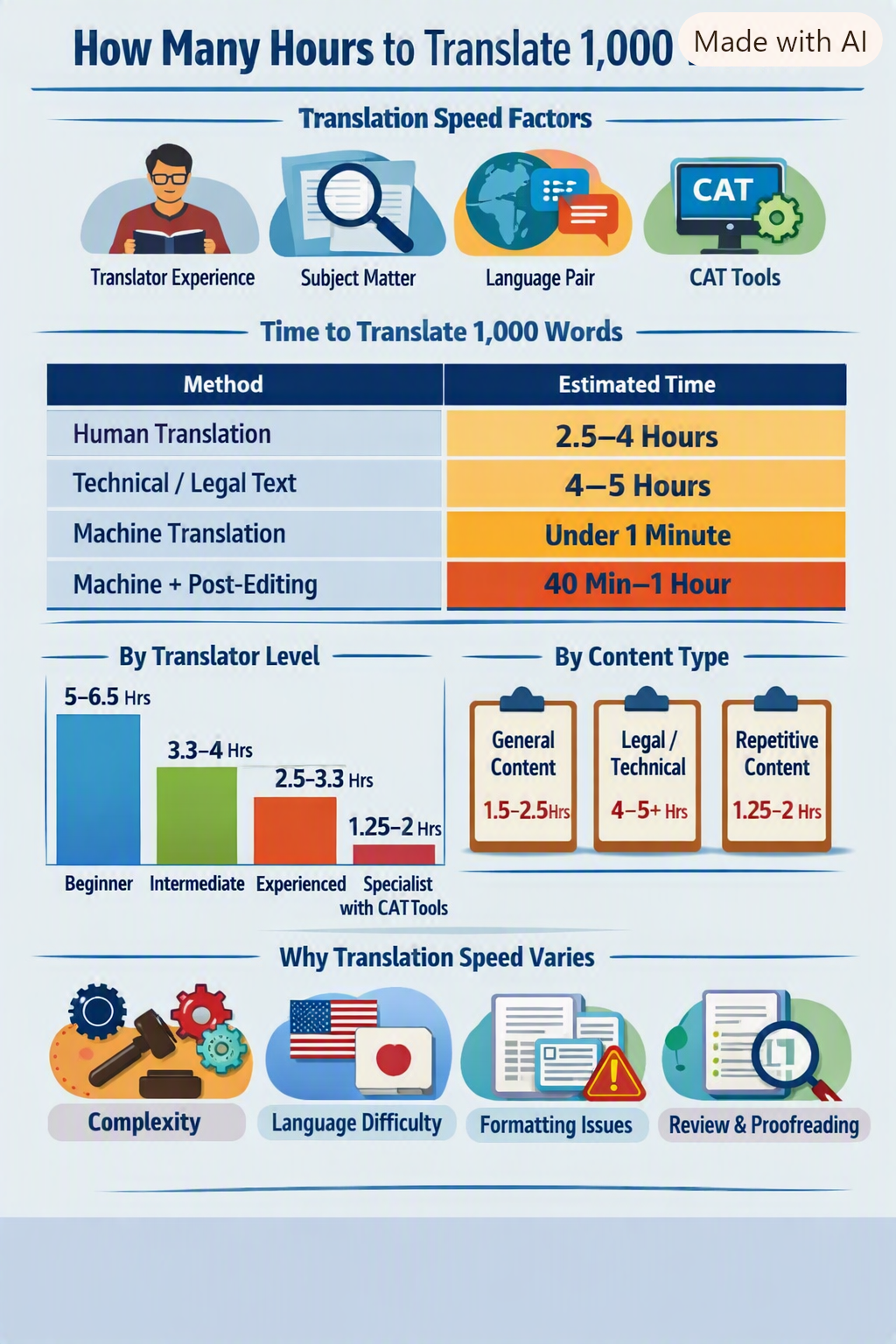
How Many Hours Does It Take to Translate 1000 Words?
Quick Answer: Translating 1,000 words typically takes 2 to 4 hours for a professional human translator, based on an average output of 300–400 words per hour. Simple content can take as little as 1.5 hours, while technical, legal, or medical text can take 5 hours or more once quality review and proofreading are included.
What Determines Translation Time for 1000 Words
Translation speed is not fixed. It changes based on the translator’s experience, the subject matter, the language pair, and whether translation memory or machine-assisted tools are used. The table below breaks down realistic time ranges by scenario.
Translation Time by Translator Experience Level
| Translator Level | Average Speed (Words/Hour) | Time for 1,000 Words |
|---|---|---|
| Beginner translator | 150–200 | 5–6.5 hours |
| Intermediate translator | 240–300 | 3.3–4 hours |
| Experienced professional | 300–400 | 2.5–3.3 hours |
| Specialist with CAT tools (repetitive content) | 500–800 | 1.25–2 hours |
Industry data from translation provider Pactranz identifies 300 words per hour and roughly 2,500 words per day as a realistic benchmark for a quality-focused professional. The same source notes that actual output varies widely across the industry, ranging from about 200 to 500 words per hour and 1,200 to 4,000 words per day depending on the translator and project.
Other sources report higher averages. Training for Translators, a resource for working linguists, puts the typical range closer to 400 to 600 finished words per hour, a figure that generally reflects experienced translators working in a familiar subject area.
Translation Time by Content Type and Difficulty
The subject matter of a document has a major effect on how fast a translator can work. Repetitive or simple content moves quickly. Dense, technical, or legally sensitive material requires more research and precision, which slows output.
- General/marketing content: Higher speed due to flexible phrasing and fewer technical constraints.
- Repetitive content (e.g., surveys, product listings): Translation platform GetBlend notes that highly repetitive material can push output to around 800 finished words per hour.
- Legal and technical documents: Slower due to cross-referencing and precise terminology. GetBlend reports that dense legal documents with layered meaning and heavy cross-referencing can drop output to as low as 200 to 250 words per hour.
- Medical and pharmaceutical translation: Requires terminology verification, similarly reducing speed to the 200–300 words-per-hour range.
Cause and Effect: Why Complexity Slows Down Translation
| Cause | Effect on Speed |
|---|---|
| Unfamiliar terminology | Increases research time, reducing words/hour |
| Legal or regulatory language | Requires precision checks, slowing output |
| Repetitive or templated text | Increases speed via pattern reuse |
| Use of CAT tools with translation memory | Can increase speed 10–20% on repetitive projects |
| Poor source document formatting | Adds manual cleanup time |
Full Project Turnaround Time vs. Active Translation Time
It is important to separate active translation time (the hours spent typing the translation) from total turnaround time (which includes project setup, self-review, editing, and proofreading before delivery).
According to translation benchmarks published by Pactranz, typical full-service turnaround times — including quality review — are:
- Up to 1,000 words: 1–2 days
- 1,000–3,000 words: 2–3 days
- 3,000–5,000 words: 3–4 days
- 5,000–10,000 words: 4–6 days
These estimates are built on the same 300-words-per-hour, 2,500-words-per-day benchmark, with turnaround times calculated for a single translator handling the entire project, including self-review.
This means that while the typing portion of translating 1,000 words might only take 2.5–3.5 hours, agencies often quote 1–2 business days to account for quality assurance, formatting, and scheduling around a translator’s existing workload.
Human Translation vs. Machine Translation Speed
Machine translation and AI-assisted post-editing dramatically change the time equation. Research on post-editing speed shows how much faster the process becomes when translators edit machine-generated text rather than translating from scratch.
A 2020 academic study covered by translation industry publication Slator found that a small group of professional translators averaged about 1,500 words per hour when post-editing news articles that had already been machine-translated. A separate 2019 industry survey reported by Slator found an even wider range, with top performers exceeding 5,000 words per hour and about half of post-editors falling between 1,000 and 3,000 words per hour.
Comparison: Time to Translate 1,000 Words by Method
| Method | Estimated Time for 1,000 Words |
|---|---|
| Human translation (from scratch) | 2.5–4 hours |
| Human translation of technical/legal text | 4–5 hours |
| Machine translation (raw output) | Under 1 minute |
| Machine translation + human post-editing | 40 minutes–1 hour |
Raw machine translation is instant but carries accuracy risks, particularly for nuanced, legal, or culturally specific content. Human post-editing of machine output is the fastest method that still maintains professional quality control.
Factors That Affect How Long It Takes to Translate 1000 Words
- Language pair difficulty — Translating between linguistically similar languages (e.g., Spanish to Italian) is generally faster than between structurally distant languages (e.g., English to Japanese or Arabic).
- Translator experience level — Experienced translators develop faster pattern recognition and terminology recall.
- Subject-matter familiarity — A translator specializing in a field will work faster within that niche than outside it.
- Use of CAT tools and translation memory — Repetitive projects benefit most; new, unique content sees smaller speed gains.
- Required review depth — Certified, legal, or medical translations require additional proofreading cycles.
- Document formatting — Scanned PDFs, complex layouts, or embedded graphics increase non-translation labor time.
How Many Hours to Translate Documents of Different Lengths
| Word Count | Estimated Active Translation Time (at 300 wph) | Typical Agency Turnaround |
|---|---|---|
| 500 words | 1.5–2 hours | Same day–1 day |
| 1,000 words | 2.5–4 hours | 1–2 days |
| 2,500 words | 6–8 hours | 2–3 days |
| 5,000 words | 12–16 hours | 3–4 days |
| 10,000 words | 24–33 hours | 4–6 days |
Frequently Asked Questions
How long does it take to translate 1000 words professionally?
A professional translator typically needs 2.5 to 4 hours of active work to translate 1,000 words, based on an average industry speed of 300–400 words per hour. Full agency turnaround, including proofreading, is usually quoted as 1–2 business days.
How many words can a translator translate in an hour?
Most professional translators produce 200 to 400 words per hour on standard content, though this can rise to 600–800 words per hour for simple or repetitive text, or drop to 200–250 words per hour for complex legal or medical documents requiring precision review.
How many words can a translator translate in a day?
A realistic daily output for a professional human translator is 2,000 to 2,500 finished words, assuming a standard workday with breaks, research time, and self-review. Agencies commonly set deadlines around 2,000–3,000 words per day.
Is machine translation faster than human translation?
Yes. Raw machine translation processes 1,000 words in seconds, and human post-editing of machine output can take as little as 40 minutes to 1 hour per 1,000 words. However, machine translation alone lacks the contextual accuracy of a trained human translator for nuanced or high-stakes content.
Does translation speed vary by language pair?
Yes. Structurally similar languages, such as Spanish and Portuguese, translate faster than distant language pairs, such as English and Mandarin, because of differences in grammar, sentence structure, and cultural context that require more adaptation.
Why do agencies quote 1–2 days for a 1000-word translation if it only takes hours to type?
Turnaround estimates include more than typing time. They factor in self-review, editing, formatting, project scheduling, and quality assurance steps, which is why a task requiring 2.5–4 hours of active translation is often quoted with a 1–2 day delivery window.
Do certified translations take longer than standard translations?
Yes. Certified translations, often required for immigration, legal, or academic documents, involve additional verification, formatting to match the source document, and a signed certification statement, which typically adds time beyond standard translation and proofreading.
Related Reading
- How Much Does Professional Translation Cost Per Word
- Machine Translation vs. Human Translation: Accuracy Comparison
- How to Choose a Certified Translation Service in the United States
- CAT Tools Explained: How Translation Memory Speeds Up Projects
- discover How Much Do Interpreters Cost Per Hour? through this linkhttps://global-ethos.com/how-much-do-interpreters-cost-per-hour-u-s-pricing-guide/
Authoritative Sources Referenced
- American Translators Association (ATA) — industry certification standards for professional translators in the United States
- Pactranz — realistic translation speed and turnaround benchmarks
- Slator — translation industry research and post-editing speed studies
- GetBlend — translator output and CAT tool efficiency research