What Are the Limitations of ChatGPT Translation?
ChatGPT translation is limited by uneven accuracy across languages, weaker performance on low-resource languages, occasional hallucinated or omitted content, inconsistent terminology, and limited cultural and legal nuance. It also lacks guaranteed confidentiality and certification. For high-stakes legal, medical, or regulated content, human review is still required.
Table of Contents
- How ChatGPT Translates Text
- Key Limitations of ChatGPT Translation
- ChatGPT vs. Google Translate, DeepL, and Human Translators
- Is ChatGPT Translation Good Enough for Legal, Medical, and Business Use?
- How to Reduce ChatGPT Translation Errors
- When to Use a Professional Translator
- FAQs
How ChatGPT Translates Text
ChatGPT is a large language model (LLM) developed by OpenAI. It is not a dedicated machine translation engine.
It predicts the most probable next words based on patterns learned from large multilingual text datasets. Translation is one of many tasks it can perform.
This differs from neural machine translation (NMT) systems such as Google Translate, DeepL, and Microsoft Translator, which are trained and tuned specifically for translation.
Cause and effect: Because ChatGPT generates text probabilistically, its output is fluent but not always faithful to the source. The same input can also produce different translations on different runs.
you can discover is chatgpt or google transalte more accurate through this link https://global-ethos.com/is-chatgpt-or-google-translate-more-accurate/
What ChatGPT does well
- Everyday text in widely spoken languages such as Spanish, French, and German
- Adjusting tone, formality, and reading level on request
- Explaining ambiguous phrases and offering alternative renderings
- Handling short context across a conversation
Research supports this. In its GPT-4 research release, OpenAI reported that GPT-4 outperformed the English-language performance of GPT-3.5 on a translated version of the MMLU benchmark in 24 of 26 languages tested (Source: OpenAI).
The limitations below matter most when accuracy, accountability, or cultural fit is critical.
Key Limitations of ChatGPT Translation
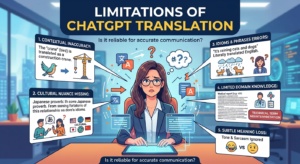
1. Uneven accuracy across languages
Performance depends heavily on how much training data exists for a language.
A Microsoft Research study, “How Good Are GPT Models at Machine Translation?”, found that GPT models were competitive for high-resource languages but more limited for low-resource ones (Source: Hendy et al., Microsoft Research, 2023).
Effect: Quality for languages such as Spanish or French cannot be assumed for languages with less online text, including many African, Indigenous, and regional languages.
2. Hallucinations and omissions
ChatGPT can add information that is not in the source text, skip sentences, or restate a meaning incorrectly while sounding natural.
Academic work on hallucinations in machine translation shows this is a known failure mode of translation systems (Source: Guerreiro et al., 2023).
Why it matters: Fluent errors are harder to catch than awkward ones, especially for readers who do not know the source language.
3. Inconsistent terminology
Without a glossary, ChatGPT may translate the same term differently within one document.
- A product name may be translated in one paragraph and left in English in another
- Industry terms may vary between sections
- Brand voice may drift across long texts
Effect: Technical manuals, contracts, and software interfaces suffer most from inconsistency.
4. Limited cultural and contextual nuance
Idioms, humor, wordplay, honorifics, and regional dialects often lose meaning when translated literally.
- Spanish varies between Mexico, Spain, and U.S. Spanish
- Portuguese differs between Brazil and Portugal
- Chinese differs between Simplified and Traditional forms and by region
- Many languages encode formality in ways English does not
Unless the prompt specifies the dialect and audience, the model may default to a generic or mismatched variety.
5. Context window and long-document drift
Long documents may exceed what the model can track reliably. Names, tone, and terms can drift, and formatting can break between sections.
Effect: Translating a whole book, manual, or legal agreement in one pass raises the risk of silent inconsistencies.
6. Non-deterministic output
Running the same prompt twice can return different wording. This is a problem for workflows that need repeatable, auditable results, such as regulated documentation or version-controlled content.
7. No certification or legal accountability
ChatGPT output is not a certified translation. Courts, immigration authorities, and many government agencies require a signed statement from a qualified human translator.
In the United States, the U.S. Citizenship and Immigration Services (USCIS) requires translations of foreign-language documents to include the translator’s certification of competence and accuracy.
8. Privacy and data-handling concerns
Text entered into a consumer chatbot is processed under the provider’s terms. This can conflict with confidentiality agreements, attorney-client privilege, or privacy law.
Organizations handling sensitive data should review OpenAI’s data controls and enterprise or API terms, and consult legal or compliance teams before using any AI tool.
9. Weak handling of formatted and specialized content
- Subtitles with timing constraints
- Text embedded in images or PDFs
- Right-to-left languages such as Arabic and Hebrew in complex layouts
- Marketing copy that requires transcreation rather than literal translation
- Poetry and literary text
ChatGPT vs. Google Translate, DeepL, and Human Translators
| Factor | ChatGPT | Google Translate / DeepL | Professional human translator |
|---|---|---|---|
| Designed for translation | No (general LLM) | Yes | Yes |
| Tone and style control | Strong, via prompts | Limited | Strong |
| Consistency across runs | Variable | Higher | High, with glossaries |
| Low-resource languages | Weaker | Varies by engine | Depends on translator availability |
| Cultural nuance | Moderate | Moderate | Strongest |
| Certified translation | No | No | Yes, when certified |
| Speed and cost | Fast, low cost | Fast, low cost | Slower, higher cost |
| Accountability | None | None | Professional liability |
Takeaway: Independent evaluations show that results vary by language pair, domain, and text type. The best tool depends on the task, so test on your own content.
Is ChatGPT Translation Good Enough for Legal, Medical, and Business Use?
Legal documents
Legal translation demands exact terminology and jurisdiction-specific meaning. A single mistranslated clause can change contractual obligations.
Medical and healthcare content
In the United States, Section 1557 of the Affordable Care Act governs language access in covered health programs. HHS rules state that when machine translation is used for content critical to rights, benefits, or meaningful access, a qualified human translator must review it (Source: U.S. Department of Health and Human Services).
This directly limits unreviewed AI translation in healthcare settings.
Business and marketing content
Customer-facing content affects trust and sales. CSA Research’s survey “Can’t Read, Won’t Buy” found that 76% of consumers prefer products with information in their own language, and 40% said they would not buy from websites in other languages (Source: CSA Research).
Effect: Awkward or inaccurate translation can reduce conversions even when the text is technically understandable.
Language access in the United States
The U.S. Census Bureau reports that more than 67 million U.S. residents speak a language other than English at home (Source: American Community Survey, 2019). Federal agencies and federally funded programs have language access obligations under Title VI of the Civil Rights Act.
How to Reduce ChatGPT Translation Errors
- Specify the context. State the source language, target language and dialect, audience, and purpose.
- Provide a glossary. List required terms, brand names, and words that must not be translated.
- Set tone and formality. For example, “formal business register for U.S. Spanish readers.”
- Translate in sections. Shorter segments reduce drift and omissions.
- Ask for flagged ambiguities. Request notes on idioms or unclear source phrases.
- Check with back-translation. Translate the result back to the source language and compare meaning.
- Use a bilingual reviewer. A fluent human should approve anything public or high-stakes.
- Protect sensitive data. Remove personal or confidential information, or use an enterprise agreement with appropriate controls.
Professional workflows follow formal standards. ISO 17100 sets requirements for translation services, and ISO 18587 covers human post-editing of machine translation output (Source: International Organization for Standardization).
When to Use a Professional Translator
Hire a qualified human translator, ideally one credentialed through the American Translators Association (ATA), when:
- A document is legal, medical, financial, or regulatory
- A certified or notarized translation is required
- The content represents your brand to customers
- The language is low-resource or highly dialect-sensitive
- Errors could cause safety, financial, or legal harm
A common hybrid approach is to use AI for a first draft and a human linguist for post-editing, which can lower cost while keeping accountability.
FAQs
Is ChatGPT translation accurate?
ChatGPT translation is often accurate for common languages such as Spanish, French, and German, especially for everyday text. Accuracy drops for low-resource languages, specialized terminology, and idiomatic or culturally specific passages. Results also vary between prompts, so important content should be checked by a qualified human translator before use.
Is ChatGPT better than Google Translate?
It depends on the task. ChatGPT can adapt tone, follow style instructions, and handle context across a document, while Google Translate and DeepL are built specifically for translation and offer consistent, fast output with dedicated features. Independent evaluations show results vary by language pair and text type, so testing on your own content is advisable.
Can ChatGPT translation be used for legal or medical documents?
It should not be the sole method. Legal and medical texts require exact terminology and accountability, and errors can cause real harm. In the United States, HHS Section 1557 rules require covered health programs to have a qualified human translator review machine translation of critical content. Certified translation requires a human.
Is it safe to put confidential documents into ChatGPT for translation?
Not without review of the data settings and policies. Content entered into a consumer chatbot may be processed and stored under the provider’s terms, which can conflict with confidentiality, contractual, or privacy obligations. Organizations handling sensitive data should use enterprise or API agreements with appropriate data controls and consult their compliance teams.
Does ChatGPT hallucinate when translating?
Yes, it can. Large language models sometimes add details not in the source, omit sentences, or produce fluent text that misstates the meaning. Research on hallucinations in machine translation systems documents this behavior, and it is harder to notice because the output reads naturally. Back-translation and bilingual review help detect it.
How can you reduce ChatGPT translation errors?
Provide the source language, target dialect, audience, tone, and a glossary of required terms. Translate in smaller sections to keep context clear, ask for notes on ambiguous phrases, and verify with back-translation. Have a bilingual reviewer approve the final text, following post-editing practices such as ISO 18587 for professional workflows.