Is ChatGPT or Google Translate More Accurate?
Neither is universally more accurate. Google Translate has historically been more consistent and reliable for short text and less common languages, while ChatGPT often produces more natural, context-aware translations for high-resource languages like Spanish, French, and German. For medical, legal, or official documents, both require review by a qualified human translator.
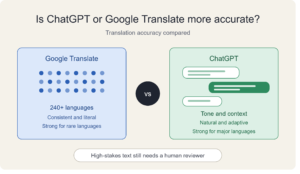
ChatGPT vs. Google Translate: Quick Comparison
| Factor | Google Translate | ChatGPT |
|---|---|---|
| Core design | Purpose-built neural machine translation (NMT) | General-purpose large language model (LLM) |
| Language coverage | More than 240 languages | Strong in major languages; variable in low-resource ones |
| Tone and context | Literal and consistent | Adapts tone, register, and style on request |
| Idioms and slang | Often translated literally | Frequently handled more naturally |
| Consistency | High for repeated phrases | Can vary between runs |
| Risk of invented content | Low | Higher (omissions or additions are possible) |
| Long documents | Handles files and web pages | Handles long text, but quality may drift |
| Best for | Quick, broad-coverage translation | Nuanced, context-rich translation in major languages |
How Machine Translation Accuracy Is Measured
Translation accuracy is not a single number. Researchers and companies use several methods:
- BLEU: Compares machine output to human reference translations by matching word sequences. It is fast but misses meaning and style.
- COMET and other neural metrics: Score translations by semantic similarity and correlate better with human judgment than BLEU.
- Human evaluation (such as MQM): Trained linguists label errors by type and severity. This is considered the most reliable standard.
The annual Conference on Machine Translation (WMT) publishes benchmark comparisons of translation systems using these methods. Results vary by language pair, domain, and text length.
you can discover is deepl owned by china through this link https://global-ethos.com/is-deepl-owned-by-china/
you can discover how to use chatgpt as atranslator through this link https://global-ethos.com/how-do-you-use-chatgpt-as-a-translator/
you can discover is there atranslator better than google tranalte through this link https://global-ethos.com/is-there-a-translator-better-than-google-translate/
you can disvoer what are the limitations of chatgpt translation through this link https://global-ethos.com/what-are-the-limitations-of-chatgpt-translation/
you can discover what is the best free translator through this link https://global-ethos.com/whats-the-best-free-translator/
you can discover What are the limitations of ChatGPT translation? through this link https://global-ethos.com/what-are-the-limitations-of-chatgpt-translation/
you can discover
Is ChatGPT Translation Free to Use? through this link https://global-ethos.com/is-chatgpt-translation-free-to-use/
you can discover What are the top 3 most useful languages to learn?through this link https://global-ethos.com/what-are-the-top-3-most-useful-languages-to-learn/
you can discover What does ﷽ mean?through this link https://global-ethos.com/what-does-%ef%b7%bd-mean/
What Is Google Translate?
Google Translate is a dedicated machine translation service from Google. It moved from phrase-based statistical translation to neural machine translation in 2016.
In the paper describing that system, Google’s researchers reported that neural translation reduced errors by an average of 60% compared with the earlier phrase-based approach (Wu et al., Google, 2016).
Google has since expanded coverage significantly. In 2024, <a href=”https://blog.google/products/translate/google-translate-new-languages-2024/”>Google announced 110 new languages</a> for Translate, bringing the total to 243 at that time.
Strengths:
- Broad language coverage, including many low-resource languages
- Predictable, repeatable output
- Built-in tools for websites, documents, images, and speech
Limitations:
- Often literal with idioms, humor, and cultural references
- Limited control over tone or audience
- Can struggle with ambiguous words without context
What Is ChatGPT’s Translation Capability?
ChatGPT, developed by OpenAI, is a large language model trained on multilingual text. It was not designed only for translation, but it can translate when prompted.
Its main advantage is that it can follow instructions. You can specify the audience, formality, and subject area, and it will adjust the output.
Strengths:
- Better handling of tone, register, and idiomatic phrasing in major languages
- Can explain word choices and offer alternatives
- Can preserve formatting or follow a glossary you provide
Limitations:
- May omit or add information without flagging it
- Output can differ between runs
- Weaker on low-resource languages in earlier research
What Does the Research Say?
Early academic comparisons
A 2023 study by Jiao et al., titled <a href=”https://arxiv.org/abs/2301.08745″>”Is ChatGPT a Good Translator?”</a>, found that ChatGPT was competitive with commercial systems, including Google Translate, on high-resource European languages. It lagged on low-resource and linguistically distant language pairs.
A separate 2023 Microsoft study, <a href=”https://arxiv.org/abs/2302.09210″>”How Good Are GPT Models at Machine Translation?”</a> (Hendy et al.), reached a similar conclusion. GPT models were competitive for high-resource languages, and quality dropped for low-resource ones.
Multilingual performance of large language models
OpenAI’s <a href=”https://arxiv.org/abs/2303.08774″>GPT-4 technical report</a> tested a translated version of the MMLU benchmark across 26 languages. OpenAI reported that GPT-4 outperformed the English-language performance of several earlier models in most of the languages tested, including low-resource ones such as Latvian, Welsh, and Swahili.
This benchmark measures multilingual comprehension, not translation quality directly. It does show that LLM capability has improved across languages.
Recent WMT results
In the 2024 WMT general translation task, LLM-based systems performed strongly, and human evaluation ranked LLM-based systems at the top in most language pairs tested (<a href=”https://www2.statmt.org/wmt24/”>WMT24</a>). This suggests the gap between LLMs and dedicated translation engines has narrowed considerably for well-supported language pairs.
Cause → effect: LLMs learn from vast multilingual text and can use surrounding context. That helps with ambiguity and tone, but it also means they can generate fluent text that departs from the source.
When Is ChatGPT More Accurate?
ChatGPT tends to perform better when:
- The language pair is high-resource (English with Spanish, French, German, Portuguese, Chinese, or Japanese).
- Context matters. Marketing copy, dialogue, and emails benefit from tone-aware translation.
- Idioms or slang appear. ChatGPT is more likely to find an equivalent expression than translate word for word.
- You can give instructions. Specifying the audience or glossary improves results.
When Is Google Translate More Accurate?
Google Translate tends to perform better when:
- The language is low-resource. Its dedicated systems and wide coverage give it an edge in many such cases.
- You need consistency. Repeated phrases are translated the same way each time.
- The text is short and literal. Signs, menus, and simple sentences are reliable use cases.
- Fidelity to the source is critical. Dedicated engines are less likely to add or drop content.
Can You Trust Either Tool for Medical or Legal Content?
Not without human review. Accuracy gaps carry real consequences in these fields.
A 2014 study in the BMJ (Patil and Davies) tested Google Translate on 10 common medical phrases across 26 languages. It found <a href=”https://www.bmj.com/content/349/bmj.g7392″>57.7% overall accuracy</a>. Google Translate has improved substantially since then, but the study shows how quickly errors can appear in clinical language.
U.S. regulators have addressed this. Under Section 1557 of the Affordable Care Act, the <a href=”https://www.hhs.gov/civil-rights/for-individuals/section-1557/index.html”>U.S. Department of Health and Human Services</a> requires certain health programs to have a qualified human translator review machine-translated content when it is critical to patients’ rights or access to care.
This matters in the United States. The U.S. Census Bureau reports that more than one in five residents age 5 and older speak a language other than English at home.
How to Get More Accurate Translations From Either Tool
- Write clear source text. Short, unambiguous sentences translate better.
- Provide context. With ChatGPT, state the audience, tone, and subject area.
- Use glossaries. Specify how technical terms and brand names should be translated.
- Back-translate. Translate the result back into the original language and check whether the meaning holds.
- Cross-check. Compare ChatGPT and Google Translate. Differences point to passages that need review.
- Use a human reviewer for high-stakes content. Legal, medical, financial, and published materials should not rely on unreviewed machine output.
What About DeepL and Other Alternatives?
DeepL, Microsoft Translator, and Amazon Translate are also widely used dedicated engines. DeepL in particular is often compared with Google Translate on European languages.
Accuracy varies by language pair and text type. Compare several tools on your own sample text rather than relying on a single ranking.
Key Takeaways
- Neither ChatGPT nor Google Translate is accurate across every language and use case.
- ChatGPT often wins on naturalness and context in high-resource languages.
- Google Translate often wins on coverage, consistency, and fidelity to the source.
- LLM translation quality has improved quickly, and the gap has narrowed for major languages.
- High-stakes translation still requires a qualified human.
Frequently Asked Questions
Is ChatGPT better than Google Translate?
It depends on the language and task. ChatGPT often handles tone, idioms, and context better in widely used languages such as Spanish, French, and German. Google Translate is typically faster, more consistent, and supports far more languages. Neither replaces a professional translator for high-stakes content.
Is Google Translate accurate enough for professional use?
Google Translate is useful for understanding the gist of text and for informal communication. It is not reliable enough for legal, medical, or contractual documents without human review. Errors in terminology, ambiguity, and low-resource languages remain common, so professionals typically use it only as a first draft.
Can ChatGPT replace a human translator?
No, not for high-stakes work. ChatGPT can produce fluent translations and adapt tone on request, but it can also omit content, invent details, or mistranslate specialized terms without warning. Certified, legal, medical, and published content should be reviewed or produced by a qualified human translator.
Which is better for rare languages?
Google Translate is generally the safer choice for low-resource languages because it supports more than 240 languages and is built specifically for translation. Research on earlier GPT models found weaker results for low-resource and linguistically distant languages, though newer models continue to improve. Test both tools with a native speaker when possible.
How can I improve ChatGPT translation accuracy?
Give ChatGPT context: name the source and target language, audience, tone, and subject area. Ask it to preserve formatting and keep specialized terms consistent, then request a back-translation to check meaning. Comparing the output against Google Translate can also reveal discrepancies worth flagging for human review.
Is it safe to use for medical documents?
Not without human review. A 2014 BMJ study found Google Translate was 57.7% accurate on common medical phrases across 26 languages, and current systems are better but still error-prone. U.S. federal rules under Section 1557 require qualified human review when machine translation is used for critical health communications.