What Are AI Translation Services?
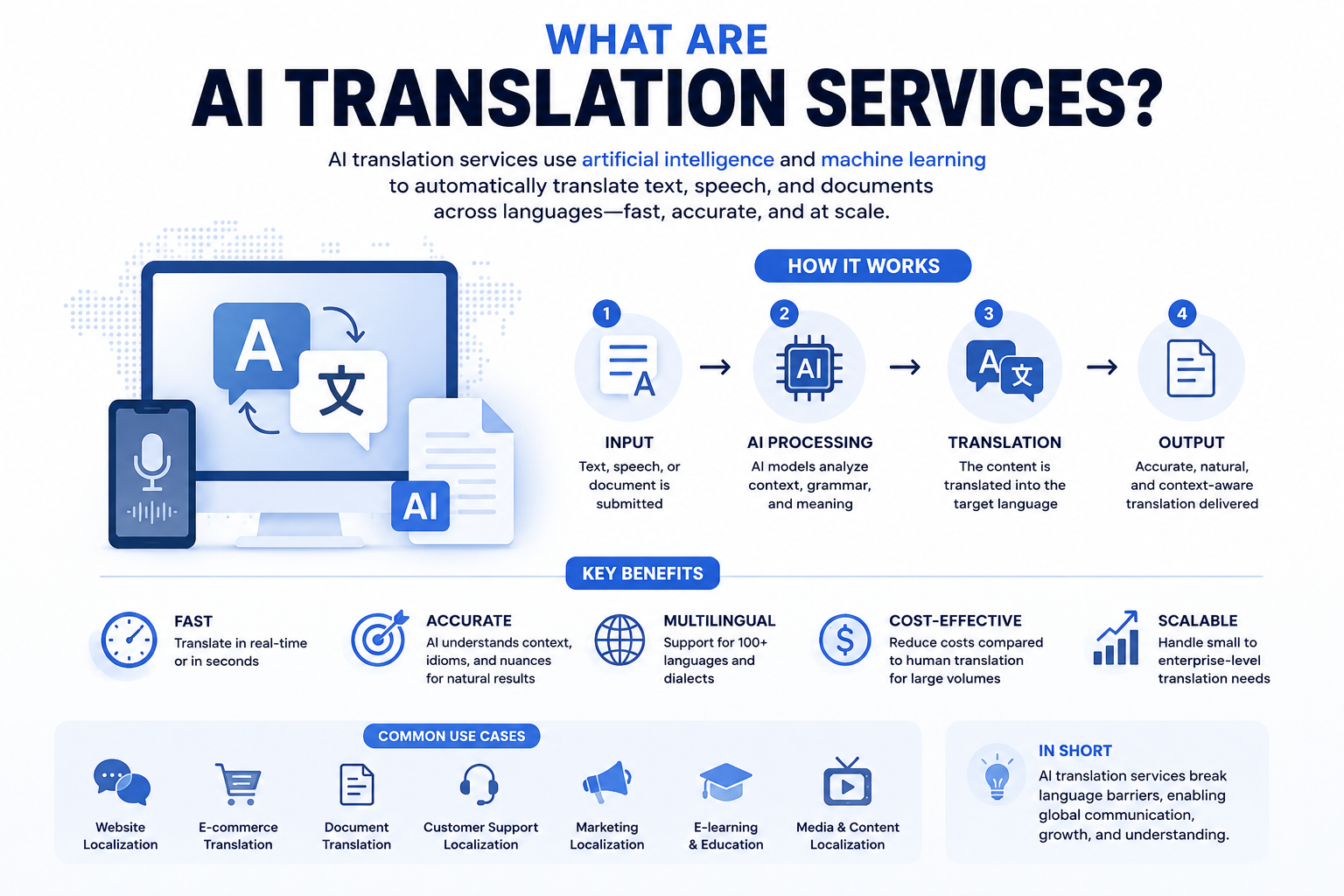
AI translation services are software tools that use artificial intelligence — primarily neural machine translation (NMT) and large language models (LLMs) — to automatically convert text, speech, or documents from one language into another. Unlike older rule-based systems, they learn language patterns from massive datasets, enabling faster, more context-aware translation across 100+ languages without human translators.
How AI Translation Services Work
AI translation services rely on deep learning models trained on billions of translated sentence pairs.
Cause → Effect: The model is exposed to large bilingual datasets → it learns statistical patterns of grammar, syntax, and meaning → it predicts the most probable translation for new, unseen text.
Most modern systems use one of two underlying technologies:
- Neural Machine Translation (NMT): Uses artificial neural networks to model entire sentences at once, producing more fluent and context-aware output than older phrase-based statistical methods.
- Large Language Models (LLMs): General-purpose AI models (such as those behind ChatGPT or Google Gemini) that translate as one of many capabilities, often better at preserving tone, idioms, and nuance.
According to Google Cloud’s documentation on Neural Machine Translation, NMT systems translate whole sentences at a time rather than piecing together fragments, which produces more grammatically accurate and natural-sounding results.
Types of AI Translation Services
1. Text Translation Tools
Convert written content between languages instantly. Examples include Google Translate, DeepL, and Microsoft Translator.
2. Speech Translation and Interpretation
Convert spoken language in real time, used in call centers, travel apps, and video conferencing platforms.
3. Document and File Translation
Preserve formatting while translating full documents, contracts, and PDFs — commonly used in legal and enterprise workflows.
4. Website and App Localization
Automatically translate and adapt digital content, including currency, date formats, and cultural references, for global audiences.
5. Machine Translation Post-Editing (MTPE)
Combines AI-generated translation with human review to improve accuracy for professional or regulated content, such as medical or legal documents.
AI Translation Services vs. Human Translation
| Factor | AI Translation | Human Translation |
|---|---|---|
| Speed | Instant to near-instant | Hours to days |
| Cost | Low to free | Higher, billed per word |
| Cultural nuance | Limited, improving with LLMs | Strong |
| Best for | High-volume, informal, or time-sensitive content | Legal, medical, marketing, and creative content |
| Scalability | Handles millions of words simultaneously | Limited by translator availability |
| Consistency | High (same rules applied every time) | Varies by translator |
Most enterprises now use a hybrid model: AI handles the first draft, and human linguists refine it through MTPE for accuracy and tone.
Why AI Translation Services Matter for Businesses
Language remains a major barrier to global commerce, and the data shows measurable business impact.
- CSA Research surveyed 8,709 consumers across 29 countries and found that 76% of online shoppers prefer to buy products with information presented in their native language, and 40% will never buy from websites in other languages (CSA Research, “Can’t Read, Won’t Buy,” 2020).
- The global AI-in-language-translation market is projected to grow from $2.94 billion in 2025 to $8.93 billion by 2030, a compound annual growth rate of 24.8% (Research and Markets, 2026).
- The broader global translation services market is expected to reach $36.35 billion by 2030 (Research and Markets, 2026).
Cause → Effect: As global e-commerce and remote work expand → demand for instant, scalable multilingual communication rises → businesses adopt AI translation to reduce cost and turnaround time.
Common Use Cases for AI Translation Services
- Customer support: Live chat and email translated instantly across regions.
- E-commerce: Product listings and reviews localized at scale.
- Healthcare: Patient intake forms and instructions translated to reduce communication errors (used cautiously, with human oversight, per guidance from the U.S. Department of Health and Human Services on language access).
- Legal and compliance: Draft translation of contracts before certified human review.
- Education: Real-time translation of lectures and course materials for international students.
- Travel and hospitality: In-app and voice translation for tourists.
Accuracy and Limitations of AI Translation Services
AI translation has improved significantly with transformer-based architectures, but it is not infallible.
Known limitations:
- Struggles with idioms, humor, and culturally specific references.
- Can misinterpret context in ambiguous sentences.
- Accuracy drops for low-resource languages with limited training data.
- May produce fluent but factually incorrect translations (“hallucinations”), a known risk with LLM-based systems.
Because of these limitations, regulated industries such as legal, medical, and government sectors typically require human-reviewed translation rather than fully automated output. HubSpot’s research on global content strategy similarly notes that machine translation works best as a starting point, not a final deliverable, for customer-facing content (HubSpot).
Leading AI Translation Services
- Google Translate — supports 130+ languages, widely used for general and travel translation.
- DeepL — known for high fluency in European languages, popular in professional settings.
- Microsoft Translator — integrated into Microsoft 365 and enterprise workflows.
- Amazon Translate — cloud-based, used for enterprise-scale document and app localization.
- ChatGPT and other LLM-based tools — used increasingly for nuanced, tone-sensitive translation tasks.
How to Choose an AI Translation Service
- Define your use case. Casual browsing needs differ from legal or medical translation.
- Check supported languages. Coverage varies significantly between providers.
- Evaluate data privacy practices. Confirm how input text is stored or used for training, especially for confidential business content.
- Test for domain accuracy. Run sample translations in your specific industry terminology.
- Consider human-in-the-loop options. For high-stakes content, choose a provider offering MTPE or professional review add-ons.
Frequently Asked Questions
What is the difference between AI translation and machine translation?
Machine translation is the broader technical category; AI translation specifically refers to machine translation systems built on artificial intelligence, such as neural networks and large language models, rather than older rule-based or purely statistical methods.
Is AI translation accurate enough for business use?
AI translation is generally accurate for everyday and high-volume content but can miss nuance, idioms, and cultural context. Businesses handling legal, medical, or brand-sensitive material typically pair AI output with human post-editing for accuracy.
What languages do AI translation services support?
Coverage varies by provider. Google Translate supports over 130 languages, while tools like DeepL focus on fewer languages with higher fluency. Always confirm language support before selecting a tool for a specific market.
Can AI translation replace human translators?
AI translation cannot fully replace human translators for legal, medical, literary, or brand-critical content, where nuance and accountability matter. It is best used to speed up first drafts, with humans reviewing sensitive or high-stakes material.
Are AI translation services free?
Many AI translation services, such as Google Translate, offer free basic access, while enterprise-grade tools with higher accuracy, security, and API integration typically require paid subscriptions.
How do AI translation services handle data privacy?
Data privacy varies by provider and plan. Free consumer tools may use submitted text to improve models, while enterprise plans often include contractual guarantees against data retention or training use. Always review the provider’s privacy policy before submitting sensitive content.
What industries use AI translation services the most?
E-commerce, customer support, healthcare administration, education, and enterprise software rely heavily on AI translation for scalable, multilingual communication, according to market research from Precedence Research and Research and Markets.You can discover the difference between translation and interpretation through this linkhttps://global-ethos.com/translation-vs-interpretation/