
What Does ﷽ Mean? Meaning, Pronunciation, and Significance of the Bismillah
Direct answer: ﷽ is the Arabic phrase Bismillah ir-Rahman ir-Rahim, meaning “In the name of God, the Most Gracious, the Most Merciful.” Muslims say it before prayers, meals, and daily tasks, and it opens 113 of the Quran’s 114 chapters. The symbol is a single Unicode character (U+FDFD).
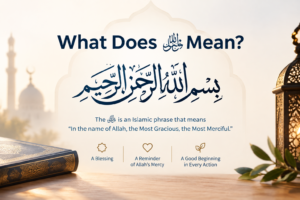
Quick Facts About ﷽
| Attribute | Detail |
|---|---|
| Arabic text | بِسْمِ ٱللَّهِ ٱلرَّحْمَٰنِ ٱلرَّحِيمِ |
| Transliteration | Bismillah ir-Rahman ir-Rahim |
| Common English translation | “In the name of God, the Most Gracious, the Most Merciful” |
| Also called | The Basmala (or Basmalah), Tasmiyah |
| Unicode code point | U+FDFD (Arabic Ligature Bismillah ar-Rahman ar-Rahim) |
| Primary use | Opening prayers, Quran recitation, meals, travel, and daily tasks |
| Religious tradition | Islam |
What Is the Meaning of the ﷽ Symbol?
The ﷽ symbol is a calligraphic ligature: one glyph that packs a full Arabic sentence into a single character. It is not a logo or a decorative design.
The phrase is called the Basmala. The name comes from the first letters of the phrase joined together, a common Arabic naming pattern (see Encyclopaedia Britannica’s entry on the Basmala).
The phrase is spoken and written by Muslims worldwide, including in the United States.
Word-by-Word Translation of Bismillah ir-Rahman ir-Rahim
Breaking the phrase into parts makes the meaning clear.
| Arabic | Transliteration | Literal meaning |
|---|---|---|
| بِسْمِ | Bi-ismi | “In the name of” |
| ٱللَّهِ | Allah | “God” |
| ٱلرَّحْمَٰنِ | Ar-Rahman | “The Most Gracious” or “The Entirely Merciful” |
| ٱلرَّحِيمِ | Ar-Rahim | “The Most Merciful” or “The Especially Merciful” |
Why are there two words for mercy?
Ar-Rahman and Ar-Rahim share the same Arabic root (r-ḥ-m), which relates to mercy and compassion. Classical commentators traditionally distinguish the two:
- Ar-Rahman describes mercy that is broad and extends to all creation.
- Ar-Rahim describes mercy that is continuous and directed toward believers.
Translators render these words differently, so English versions of the Quran vary slightly. Common alternatives include “the Beneficent, the Merciful” and “the Compassionate, the Merciful.”
Is “Allah” a different god?
No. Allah is the Arabic word for God. It is also used by Arabic-speaking Christians and Jews when referring to God in Arabic.
Where Does the Bismillah Appear in the Quran?
The Bismillah holds a structural place in the Quran. It appears in these positions:
- At the start of 113 of 114 chapters (surahs).
- Inside Surah An-Naml (27:30), where it appears in the text of a letter attributed to the Prophet Solomon (Sulayman).
- Not at the start of Surah At-Tawbah (chapter 9), the only chapter that begins without it.
This means the phrase occurs 114 times in the Quran, matching the number of chapters, even though one chapter lacks it at the opening.
you can discover Is ChatGPT or Google Translate More Accurate? through this link https://global-ethos.com/is-chatgpt-or-google-translate-more-accurate/
Why is Surah 9 the exception?
Classical scholars offered several explanations. The most common are that the chapter opens with a declaration of disassociation, and that it may be closely connected to the preceding chapter, Al-Anfal. Scholars have discussed this question for centuries, and no single explanation is universally held.
Is the Bismillah the first verse of Surah Al-Fatiha?
This depends on the school of thought. Some traditions count the Bismillah as verse 1 of Al-Fatiha, the opening chapter. Others treat it as a separate opening line and begin counting from “All praise is due to God.” You can read the chapter on Quran.com, which displays the verse numbering used by common print editions.
Why Do Muslims Say Bismillah?
Saying the Bismillah is a way to begin an action consciously, in God’s name. Its purpose is spiritual mindfulness and seeking blessing.
Cause and effect, as understood within the tradition:
- Beginning in God’s name → frames the action as done with awareness of God.
- Saying it before eating → expresses gratitude for provision.
- Saying it before travel or work → asks for protection and ease.
Common occasions for saying Bismillah
- Before eating or drinking
- Before starting the five daily prayers
- Before reciting the Quran
- Before entering the home or leaving it
- Before studying, writing, or beginning work
- At the start of formal letters and documents in many Muslim communities
Many Muslim scholars also teach that the Bismillah is meant to be said with understanding, not as an empty habit. Beliefs and practice details vary across Sunni and Shia communities and among individuals.
How Do You Pronounce Bismillah ir-Rahman ir-Rahim?
A simple English approximation:
- Bismillah: bis-mil-LAH
- Ar-Rahman: ar-rah-MAAN
- Ar-Rahim: ar-ra-HEEM
Full phrase: bis-mil-LAH ir-rah-MAAN ir-ra-HEEM.
In spoken Arabic, the words flow together, so the “ar” in each name blends into the previous sound. Listening to a recitation from a qualified teacher or a reputable Quran recitation platform is the best way to learn the nuances.
Bismillah vs. Related Islamic Phrases
People often confuse ﷽ with other common phrases. This comparison clarifies the difference.
| Phrase | Arabic | Meaning | When it is used |
|---|---|---|---|
| Bismillah | بسم الله | “In the name of God” | Beginning an action |
| Alhamdulillah | الحمد لله | “Praise be to God” | Expressing gratitude |
| InshaAllah | إن شاء الله | “If God wills” | Speaking about the future |
| SubhanAllah | سبحان الله | “Glory be to God” | Expressing awe |
| Assalamu alaikum | السلام عليكم | “Peace be upon you” | Greeting |
﷽ as a Unicode Character and in Calligraphy
Unicode details
The symbol ﷽ is encoded in the Unicode Standard at U+FDFD, within the Arabic Presentation Forms-A block. It is often noted as one of the widest single characters in Unicode because it holds an entire phrase. You can view the official code chart on the Unicode Consortium website.
Practical implications:
- Some older fonts or devices show a blank box if they lack the glyph.
- The appearance differs by font, since it is a stylized calligraphic form.
- Text-to-speech systems and screen readers may handle it inconsistently.
Calligraphy tradition
The Bismillah is one of the most frequently rendered phrases in Islamic calligraphy. Artists have written it in styles such as thuluth, naskh, diwani, and kufic, sometimes shaping the text into birds, mosques, or geometric forms. The Metropolitan Museum of Art and the Smithsonian’s Freer|Sackler galleries hold examples of Islamic calligraphic works.
﷽ in the United States: Context for U.S. Readers
Bismillah is part of everyday life for many American Muslims. Pew Research Center estimated in its 2017 report that about 3.45 million Muslims lived in the United States, roughly 1.1% of the population (source: Pew Research Center, 2017). Check Pew’s site for its latest estimates before republishing this figure. See Pew’s key findings on Muslims and Islam.
You may encounter ﷽ in the United States in these places:
- Mosques, Islamic schools, and community centers
- Social media bios and messages
- Wedding invitations and formal Muslim documents
- Art, home decor, and Quran editions
Respectful use for non-Muslims
Many Muslims regard the Bismillah as sacred. To use it respectfully:
- Avoid placing it on items that may be discarded or treated carelessly.
- Avoid jokes or casual, decorative use without understanding the context.
- Ask a Muslim colleague or community leader if you are unsure.
For general guidance on Islam in America, organizations such as the Council on American-Islamic Relations (CAIR) and the Pluralism Project at Harvard University provide educational resources.
How to Type the ﷽ Symbol
- Copy and paste from a trusted source.
- Mac: Open the Character Viewer (Control + Command + Space) and search for “Bismillah.”
- Windows: Use the Emoji and Symbols panel (Windows key + period) or the Character Map app.
- Web and code: Use the HTML entity
﷽or the Unicode escape\uFDFD.
Frequently Asked Questions (FAQs)
What does ﷽ mean?
﷽ is the Arabic phrase Bismillah ir-Rahman ir-Rahim, meaning “In the name of God, the Most Gracious, the Most Merciful.” It is written as one calligraphic Unicode symbol. Muslims recite it to begin prayers, meals, and everyday activities, and it opens 113 of the Quran’s 114 chapters.
How do you pronounce Bismillah ir-Rahman ir-Rahim?
The phrase is pronounced “bis-mil-LAH ir-rah-MAAN ir-ra-HEEM.” In spoken Arabic, the words blend together smoothly. Listening to a qualified teacher or a reputable Quran recitation is the best way to learn accurate pronunciation, since transliteration in English letters is only an approximation.
Is ﷽ the same as the word Allah?
No. ﷽ is a complete phrase, while “Allah” is the Arabic word for God and only one part of it. The phrase also contains ism (name), Ar-Rahman (the Most Gracious), and Ar-Rahim (the Most Merciful). Arabic-speaking Christians also use “Allah” when referring to God.
Why do Muslims say Bismillah before actions?
Muslims say it to begin an action in God’s name, seeking blessing and mindfulness. It precedes prayers, meals, travel, studying, and work. The practice is connected to Quranic recitation, where the phrase opens nearly every chapter, and to teachings attributed to the Prophet Muhammad about beginning tasks with God’s name.
Why does Surah 9 not begin with the Bismillah?
Surah At-Tawbah (chapter 9) is the only Quranic chapter without the Bismillah at its opening. Classical scholars proposed several explanations, including that the chapter begins with a declaration of disassociation and may be a continuation of Surah Al-Anfal. Traditionally, Bismillah is not recited when starting from its first verse.
Can non-Muslims use or write the ﷽ symbol?
Non-Muslims may learn about, discuss, and quote it respectfully. Many Muslims consider it sacred, so using it decoratively, on disposable items, or in jokes can cause offense. Practices vary, so when in doubt, ask Muslim community members or consult educational guidance from organizations such as CAIR.
How do I type the ﷽ symbol on my phone or computer?
Copy and paste it from a trusted source, or use Unicode U+FDFD. On a Mac, open Character Viewer and search “Bismillah.” On Windows, use the Emoji and Symbols panel or Character Map. Some older fonts and devices may show an empty box if they lack the necessary glyph support.
Key Takeaways
- ﷽ means “In the name of God, the Most Gracious, the Most Merciful.”
- It is called the Basmala and is encoded in Unicode as U+FDFD.
- It opens 113 of the Quran’s 114 chapters and appears within Surah An-Naml (27:30).
- Muslims say it to begin actions with mindfulness and seek blessing.
- Non-Muslims should use it respectfully, since many Muslims regard it as sacred