Lorem ipsum dolor sit amet, consectetur adipiscing elit. Ut elit tellus, luctus nec ullamcorper mattis, pulvinar dapibus leo.
Translation vs. Interpretation: What’s the Difference?
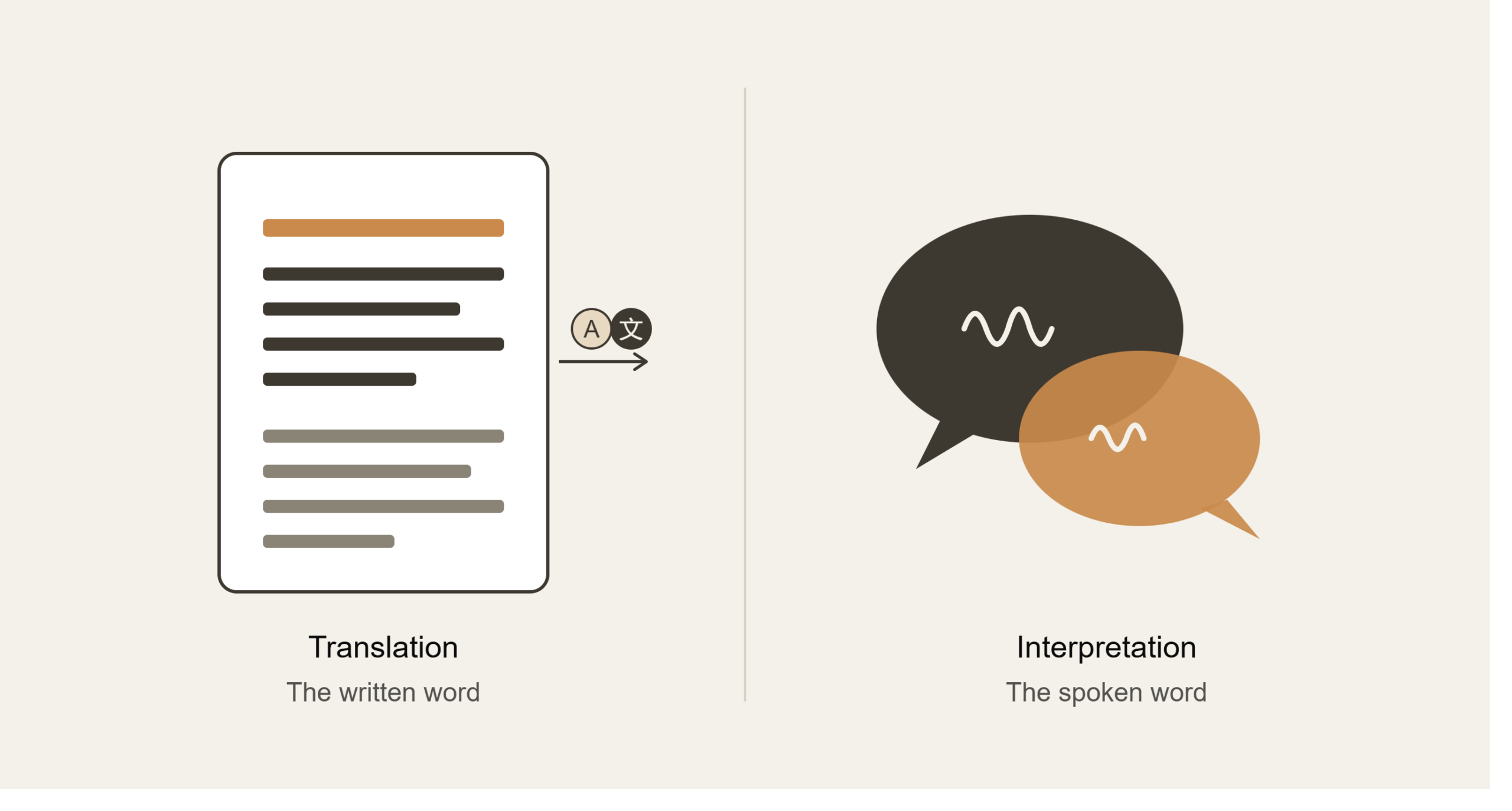
Translation converts written text from one language into another, while interpretation converts spoken or signed language in real time. Translators work with documents and have time to research and revise; interpreters work live, on the spot, converting meaning as it is spoken. Both require fluency in at least two languages, but the skills, tools, and settings differ substantially.
This distinction matters for anyone hiring language services for legal, medical, business, or government purposes, since choosing the wrong service can create compliance risk, miscommunication, or wasted budget.
Translation vs. Interpretation: Quick Comparison Table
| Factor | Translation | Interpretation |
|---|---|---|
| Format | Written text (documents, websites, contracts) | Spoken or signed language |
| Timing | Not time-sensitive; allows editing and review | Real-time or near-real-time |
| Tools used | CAT tools, glossaries, style guides, dictionaries | Memory, note-taking, sometimes audio equipment |
| Output | A written document | Spoken or signed words, unrecorded by default |
| Correction | Can be revised, proofread, edited before delivery | Cannot be revised after the fact |
| Common settings | Legal contracts, websites, marketing, manuals | Courtrooms, hospitals, conferences, live meetings |
| Standard credentialing body | American Translators Association (ATA) | National Center for State Courts (NCSC), Certification Commission for Healthcare Interpreters (CCHI) |
| U.S. median annual wage (2024) | Reported jointly by the Bureau of Labor Statistics | Reported jointly by the Bureau of Labor Statistics |
Definitions: Translation and Interpretation Explained
What Is Translation?
Translation is the process of converting written content from a source language into a target language while preserving meaning, tone, and intent. Translators typically work with:
- Legal contracts and agreements
- Websites and marketing content
- Technical manuals and user guides
- Medical records and patient documents
- Academic transcripts and certificates
Because translation is not time-bound, translators can research terminology, consult reference materials, and revise drafts before final delivery. According to the U.S. Bureau of Labor Statistics (BLS), translators convert written material, while interpreters handle spoken or signed language — a distinction the federal government itself uses to classify these as related but separate job functions.
What Is Interpretation?
Interpretation is the real-time conversion of spoken or signed language from one language into another. Interpreters do not have the benefit of revision; their output is delivered instantly and is generally not recorded or reviewable afterward.
Interpretation occurs in three primary modes:
- Simultaneous interpretation — the interpreter renders the message almost instantly while the speaker continues talking (common in conferences and courtrooms with equipment).
- Consecutive interpretation — the speaker pauses periodically so the interpreter can render segments of speech (common in medical appointments and depositions).
- Sight translation — the interpreter reads a written document aloud in the target language in real time, blending elements of both translation and interpretation.
The National Center for State Courts (NCSC) certifies court interpreters specifically in all three of these modes, underscoring that interpretation is a distinct, live-performance skill set.
Key Differences Between Translation and Interpretation
1. Medium: Written vs. Spoken
Translation always involves a written source and a written target. Interpretation always involves spoken or signed communication. This is the single most important distinction and the source of nearly every other difference on this list.
2. Time Pressure and Revision
- Translators can pause, research unfamiliar terms, consult subject-matter experts, and revise multiple drafts.
- Interpreters must process, convert, and deliver meaning within seconds, with no opportunity to “undo” a rendering once spoken.
3. Tools and Technology
Translators commonly rely on Computer-Assisted Translation (CAT) tools, translation memory databases, and terminology glossaries to maintain consistency across large volumes of text. Interpreters rely primarily on memory, structured note-taking systems (for consecutive interpretation), and sometimes simultaneous interpretation equipment such as headsets and booths.
4. Required Skill Set
| Skill | Translation | Interpretation |
|---|---|---|
| Writing proficiency | Essential | Not required |
| Public speaking / vocal delivery | Not required | Essential |
| Research and reference use | Extensive | Minimal (must know terms in advance) |
| Short-term memory and note-taking | Not applicable | Essential |
| Cultural and idiomatic fluency | Required | Required |
5. Certification and Standards Bodies
In the United States, translation and interpretation are certified separately:
- Translators can pursue certification through the American Translators Association (ATA), which has offered a credentialing exam since 1973 across roughly 30 language pairs. Pass rates for the ATA certification exam run around 20%, reflecting its rigor.
- Court interpreters are certified through the NCSC’s oral performance exam, which tests sight translation, consecutive interpretation, and simultaneous interpretation, each requiring a minimum score of 70%.
- Federal court interpreters working in Spanish can pursue the Federal Court Interpreter Certification Examination (FCICE), administered by the Administrative Office of the U.S. Courts.
- Healthcare interpreters can be certified through the Certification Commission for Healthcare Interpreters (CCHI) or the National Board of Certification for Medical Interpreters.
No single credential covers both disciplines, which is formal recognition that translation and interpretation require different tested competencies.
Why the Distinction Matters: Legal, Medical, and Business Contexts
Legal Settings
U.S. courts require interpreters — not translators — for live proceedings such as hearings, depositions, and trials. Under Title VI of the Civil Rights Act of 1964, any organization receiving federal funding, including many courts and hospitals, must provide language access to individuals with limited English proficiency (LEP). This requirement is why nearly every state participates in the NCSC’s Council of Language Access Coordinators to standardize interpreter certification.
Written legal documents (contracts, statutes, filings) require certified translation, often with a signed certificate of accuracy, especially for immigration or court-admissible documents.
Healthcare Settings
Hospitals need interpreters for real-time patient-provider communication and translators for written materials like discharge instructions, consent forms, and patient education handouts. Federal guidance under Title VI applies here as well, requiring healthcare providers receiving federal funding to supply competent language assistance to LEP patients.
Business and Localization
Global businesses typically need both services simultaneously: translation for websites, product manuals, and marketing collateral, and interpretation for live negotiations, international sales calls, and multilingual conferences. Industry research shows that 72.4% of consumers say they are more likely to purchase a product when information is presented in their own language, according to IMARC Group’s Language Services Market report, underscoring why written translation directly affects revenue.
Translation vs. Interpretation: Career and Market Data
The language services industry sits at a multibillion-dollar scale in the United States and globally:
- The global language services market was valued at roughly $75–78 billion in 2024, with projections reaching over $111 billion by the early 2030s, according to IMARC Group.
- In the U.S., the BLS reported approximately 78,300 interpreter and translator jobs in 2023, with about 32% of professionals self-employed, according to BLS data cited by Slator, an industry publication covering the language services market.
- The median annual wage for interpreters and translators combined was $59,440 as of May 2024, according to the BLS Occupational Outlook Handbook.
- Employment in this combined occupation is projected to grow just 2% from 2024 to 2034, slower than the average for all occupations, though about 6,900 openings are still projected annually due to workforce turnover, per the BLS.
- The BLS notes that job prospects are best for those holding professional certification, whether ATA certification for translation or NCSC/CCHI certification for interpretation.
These government-sourced figures show that while overall employment growth has cooled compared to earlier decades (previous BLS forecasts projected 18–24% growth in earlier reporting cycles), certified professionals in high-demand language pairs and specialties (healthcare, legal, and technical/scientific translation) continue to command higher wages, with top-paying sectors such as scientific research and development reporting mean annual wages above $126,000, according to BLS-sourced industry analysis.
Can the Same Person Be Both a Translator and an Interpreter?
Yes, but it is uncommon for one person to be equally skilled and certified in both. The two disciplines demand different cognitive skills: translation rewards deliberate, research-driven writing, while interpretation rewards fast auditory processing and verbal delivery under pressure. Professionals who do both usually specialize heavily in one and practice the other only occasionally.
Machine Translation and AI: How They Fit In
Machine translation tools (like neural MT engines) and AI have automated significant portions of written translation workflows, particularly for repetitive or lower-risk content. However, human translators remain essential for legally binding, medical, or creative content requiring nuance and accountability.
Real-time interpretation is harder to automate reliably because it requires:
- Instant handling of accents, background noise, and interruptions
- Cultural context and tone-matching in the moment
- Legal or ethical accountability in high-stakes settings such as courtrooms
Industry analysts note that AI and machine translation are improving speed and consistency in written translation workflows, but human-driven interpretation continues to dominate high-stakes live communication, according to ResearchAndMarkets’ Language Services Market report.
Frequently Asked Questions
Is a translator the same as an interpreter?
No. A translator works with written text and has time to research and revise. An interpreter converts spoken or signed language in real time, with no opportunity for revision. They require different skills, tools, and often different professional certifications, even though both demand fluency in multiple languages.
Which is harder, translation or interpretation?
Neither is universally “harder” — they demand different skills. Translation requires precision, research, and writing craft over time. Interpretation requires split-second processing, strong memory, and composure under pressure, since there is no chance to revise a spoken rendering once delivered.
Do hospitals need translators or interpreters?
Hospitals need both. Interpreters handle live conversations between patients and providers, while translators convert written materials like consent forms, discharge instructions, and patient education documents. Federal Title VI guidance requires federally funded healthcare providers to offer competent language access for both.
What certification does a court interpreter need in the U.S.?
Court interpreters are typically certified through the National Center for State Courts (NCSC) oral exam, covering sight translation, consecutive interpretation, and simultaneous interpretation, or through the Federal Court Interpreter Certification Examination for Spanish. A minimum score of 70% is required in each exam component.
How much do translators and interpreters earn in the U.S.?
As of May 2024, the median annual wage for interpreters and translators combined was $59,440, according to the U.S. Bureau of Labor Statistics. Earnings vary widely by specialty, with scientific and federal government roles paying significantly above the median, and self-employed professionals seeing income tied to language pair and certification.
Can AI replace human translators and interpreters?
AI and machine translation have automated much of routine written translation, but human translators remain necessary for legal, medical, and creative content requiring accountability and nuance. Live interpretation is harder to automate reliably due to real-time contextual, accent, and ethical demands, particularly in courtrooms and hospitals.
What’s the difference between simultaneous and consecutive interpretation?
Simultaneous interpretation happens almost instantly while the speaker keeps talking, typically using equipment like headsets, and is common at conferences and in courtrooms. Consecutive interpretation involves the speaker pausing periodically so the interpreter can render segments, common in medical visits, depositions, and small meetings.
.you can dicover what are ai translation services through this link https://global-ethos.com/what-are-ai-translation-services/
- Entities Covered: U.S. Bureau of Labor Statistics (BLS), American Translators Association (ATA), National Center for State Courts (NCSC), Federal Court Interpreter Certification Examination (FCICE), Certification Commission for Healthcare Interpreters (CCHI), National Board of Certification for Medical Interpreters (NBCMI), Title VI of the Civil Rights Act of 1964, IMARC Group, Slator, ResearchAndMarkets