What Are AI Translation Systems? A Complete Guide
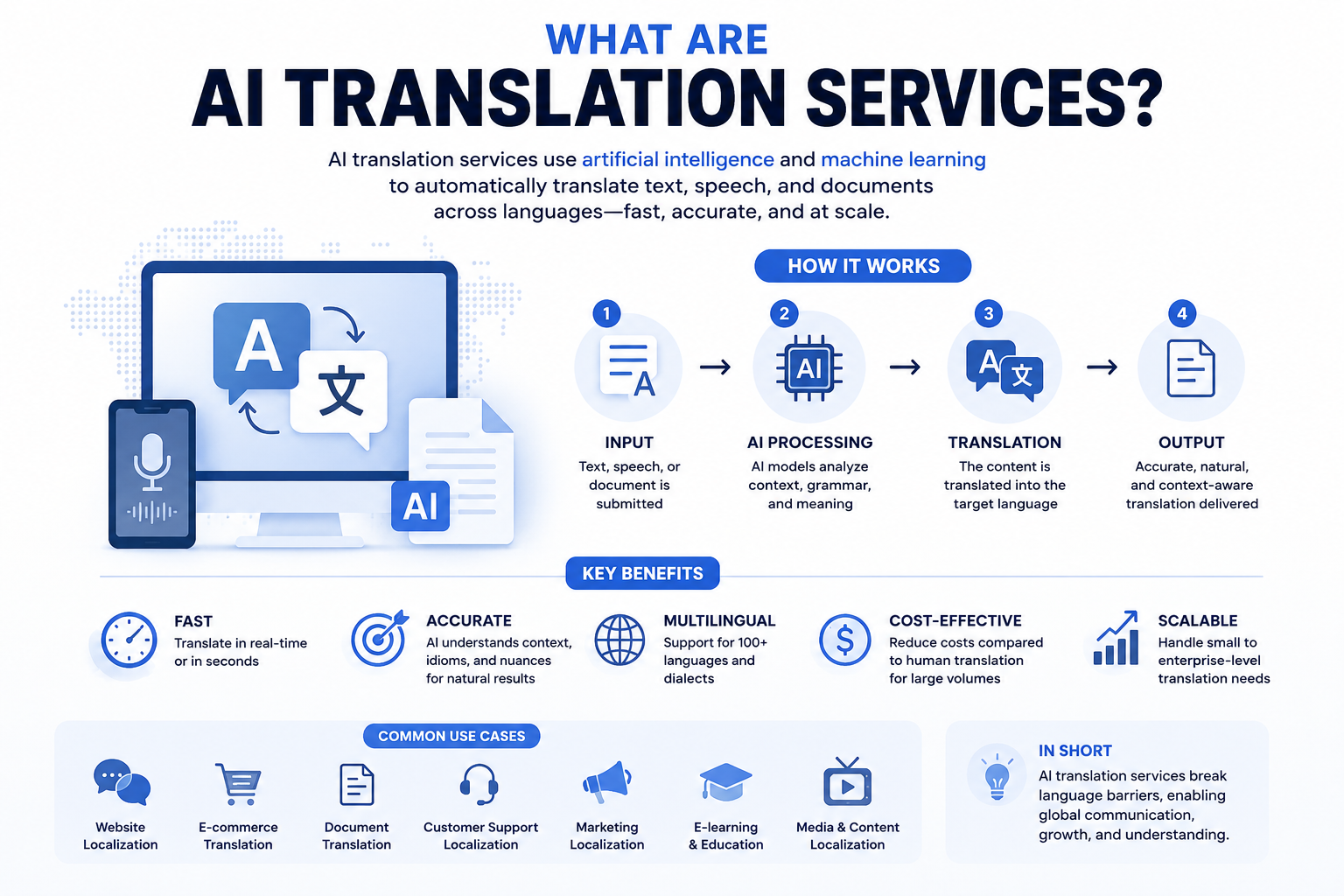
AI translation is the use of artificial intelligence, primarily neural machine translation (NMT) and large language models, to automatically convert text or speech from one language into another. Unlike older rule-based or statistical systems, AI translation learns language patterns from massive bilingual datasets, allowing it to produce more natural, context-aware translations in real time across text, voice, and video.
What Does AI Translation Mean in Simple Terms
AI translation refers to software that uses machine learning models to understand the meaning of a sentence in one language and generate an equivalent sentence in another language, without direct human involvement in each translation.
Modern AI translation tools rely on neural networks trained on billions of sentence pairs. This lets them:
- Recognize context, not just individual words
- Handle idioms, tone, and grammar more accurately than older systems
- Translate instantly across text, speech, images, and video
- Improve over time as models are retrained on more data
According to market data compiled from industry research, 500 million people use Google Translate daily, with over 70% of European language professionals incorporating machine translation into their workflows. This scale of adoption shows AI translation has moved from a novelty tool to core communication infrastructure. sonix
How AI Translation Works
AI translation systems generally follow four stages:
- Input processing – The source text or audio is broken into tokens (words or sub-word units) the model can analyze.
- Encoding – A neural network converts the input into a numerical representation capturing meaning and context, not just individual words.
- Decoding – The model generates the target-language output word by word, predicting the most contextually appropriate translation.
- Post-processing – Formatting, punctuation, and in some systems, tone or style adjustments are applied before the final output is returned.
This process happens in milliseconds, which is why AI translation can power live captions, real-time voice interpretation, and instant webpage translation.
Neural Machine Translation (NMT) vs Older Methods
| Method | How It Works | Context Awareness | Common Use Today |
|---|---|---|---|
| Rule-Based Machine Translation (RBMT) | Uses hand-coded grammar and dictionary rules | Very low | Largely obsolete |
| Statistical Machine Translation (SMT) | Predicts translations based on word/phrase frequency in bilingual corpora | Low to moderate | Mostly replaced |
| Neural Machine Translation (NMT) | Uses deep neural networks to model entire sentences | High | Dominant standard |
| Large Language Model (LLM) Translation | Uses generative AI models (e.g., GPT, Gemini, Claude) trained on diverse multilingual text | Very high, including tone and style | Rapidly growing |
Neural Machine Translation now dominates the industry. Research compiled by translation-technology analysts shows NMT technology holds 48.67% of the translation market share, reflecting the industry’s shift toward AI-powered approaches over traditional methods. sonix
AI Translation vs Human Translation
AI translation and human translation serve different purposes, and the best approach often combines both.
| Factor | AI Translation | Human Translation |
|---|---|---|
| Speed | Instant to near-instant | Hours to days |
| Cost | Low to free for basic use | Higher, priced per word |
| Cultural nuance | Improving, but can miss subtlety | Strong, especially for idioms and tone |
| Consistency | High across large volumes | Can vary between translators |
| Best for | High-volume content, real-time communication, first drafts | Legal, medical, literary, and brand-sensitive content |
Government and academic sources support using human review for high-stakes content. The U.S. Department of Health and Human Services and similar public health bodies recommend certified human translators for medical and legal documents, since mistranslation in these fields carries safety and compliance risks.
Types of AI Translation Technology
1. Text Translation
Converts written content between languages instantly. Examples include Google Translate, DeepL, and Microsoft Translator.
2. Speech Translation
Converts spoken language into another spoken or written language in real time, used in travel apps, call centers, and international meetings.
3. Machine Interpretation
A subset of speech translation focused on live, conversational interpretation, often used in customer service and telehealth.
4. Visual/Image Translation
Uses optical character recognition (OCR) combined with AI translation to translate text captured through a camera, such as signs or menus.
5. Document and Website Localization
Translates entire documents or websites while preserving formatting, used heavily in e-commerce and enterprise software.
Why AI Translation Has Grown So Quickly
Three forces are driving adoption, according to industry analysis:
- Explosive content growth – Businesses generate far more multilingual content than human teams can translate manually.
- Model quality improvements – Large language models now produce publication-quality first drafts in many language pairs.
- Cost of unmanaged translation – Companies increasingly view multilingual communication as a revenue driver rather than an operational afterthought.
Market data reflects this shift. The AI translation market grew from $1.88 billion in 2023 to $2.34 billion in 2024, representing a 24.9% compound annual growth rate. Separate industry estimates project the broader AI-in-language-translation market will reach roughly $8 billion to $9 billion by 2030, based on analysis from research firms including CSA Research, Slator, and The Business Research Company. Estimates vary by methodology, so figures should be treated as directional rather than exact. sonix
How Accurate Is AI Translation
Accuracy in AI translation depends heavily on the language pair, content type, and domain.
- Google Translate achieves approximately 94% accuracy for Spanish medical instructions, 90% for Tagalog, and 82.5% for Korean, illustrating how accuracy varies significantly by language. sonix
- Over 40% of universities integrated AI speech translation tools in 2024, expanding access for international students, but institutions typically pair these tools with human oversight for academic and administrative documents. sonix
- Among professional users, 83% of the marketers who use machine translation express confidence in its quality, showing growing professional trust even as human review remains standard for sensitive content. sonix
Key takeaway: AI translation accuracy is generally high for widely spoken language pairs like Spanish-English or French-English, and lower for low-resource languages with less training data.
Common Use Cases for AI Translation
- E-commerce: Translating product listings and customer reviews for global marketplaces
- Customer support: Real-time chat and voice translation for multilingual service teams
- Healthcare: Bridging communication gaps between patients and providers (with certified human review for clinical decisions)
- Travel: Instant translation apps for signs, menus, and conversations
- Enterprise software: Localizing user interfaces and documentation at scale
- Media and video: Auto-generating subtitles and dubbing across languages
Limitations of AI Translation
AI translation is powerful but not infallible. Common limitations include:
- Idiomatic expressions can be translated literally, losing intended meaning
- Low-resource languages have less training data, reducing accuracy
- Cultural context and tone may be missed, especially in marketing or literary content
- Ambiguous phrases can be mistranslated when context is limited
- Specialized terminology in legal, medical, or technical fields may require domain-specific training data
Because of these limitations, organizations handling regulated or high-stakes content typically use a human-in-the-loop model: AI generates a first draft, and a qualified human translator reviews and refines it.
Leading AI Translation Tools and Providers
- Google Translate – Free, widely used consumer tool covering over 100 languages
- DeepL – Known for strong performance on European language pairs
- Microsoft Translator – Integrated into Microsoft 365 and enterprise workflows
- Amazon Translate – Cloud-based API for developers and enterprises
- ChatGPT, Claude, and Gemini – General-purpose AI models increasingly used for nuanced, context-aware translation and localization tasks
Each tool uses variations of neural machine translation or large language model architecture, and performance can differ meaningfully by language pair and content type.
Frequently Asked Questions
What is AI translation in simple terms?
AI translation is technology that uses machine learning, primarily neural networks, to automatically convert text or speech from one language into another. It analyzes context rather than translating word-for-word, which produces more natural results than older rule-based translation systems.
Is AI translation accurate?
Accuracy varies by language pair and content type. Common language pairs like Spanish-English can reach over 90% accuracy for straightforward text, while low-resource languages and technical or idiomatic content often see lower accuracy and benefit from human review.
What is the difference between machine translation and AI translation?
Machine translation is the broader category covering any automated translation method, including older rule-based and statistical systems. AI translation specifically refers to neural network-based and large language model approaches, which are the current industry standard.
Can AI translation replace human translators?
AI translation can handle high-volume, low-stakes content efficiently, but human translators remain essential for legal, medical, literary, and brand-sensitive material where cultural nuance, legal accuracy, and tone matter significantly.
What languages does AI translation support?
Leading tools like Google Translate and Microsoft Translator support over 100 languages, though translation quality is generally strongest for widely spoken languages with abundant training data, such as Spanish, French, and Mandarin.
How does neural machine translation differ from older AI translation methods?
Neural machine translation analyzes entire sentences for context and meaning, while older statistical and rule-based systems translated word-by-word or phrase-by-phrase. This shift is why NMT now holds nearly half of the translation technology market.
Is AI translation free to use?
Many consumer tools like Google Translate and Microsoft Translator offer free access for basic translation. Enterprise-grade tools with API access, custom terminology, and higher volume limits typically require a paid subscription.
You can discover the difference between translation and interpretation through this linkhttps://global-ethos.com/translation-vs-interpretation/