# Which Translation of the Odyssey Is Actually the Best? (A 2026 Deep Dive)
## Key takeaways
– There are more than 60 complete English translations of the Odyssey, starting with George Chapman in 1614 — so “best” always means best *for a specific reader*, not one objective winner.
– Emily Wilson’s 2017 translation has now sold over a million copies domestically, with a fresh sales spike tied to Christopher Nolan’s 2026 film adaptation.
– Every translator has to make a defining choice on the poem’s very first line — the word *polytropos* — and that one decision predicts almost everything else about their style.
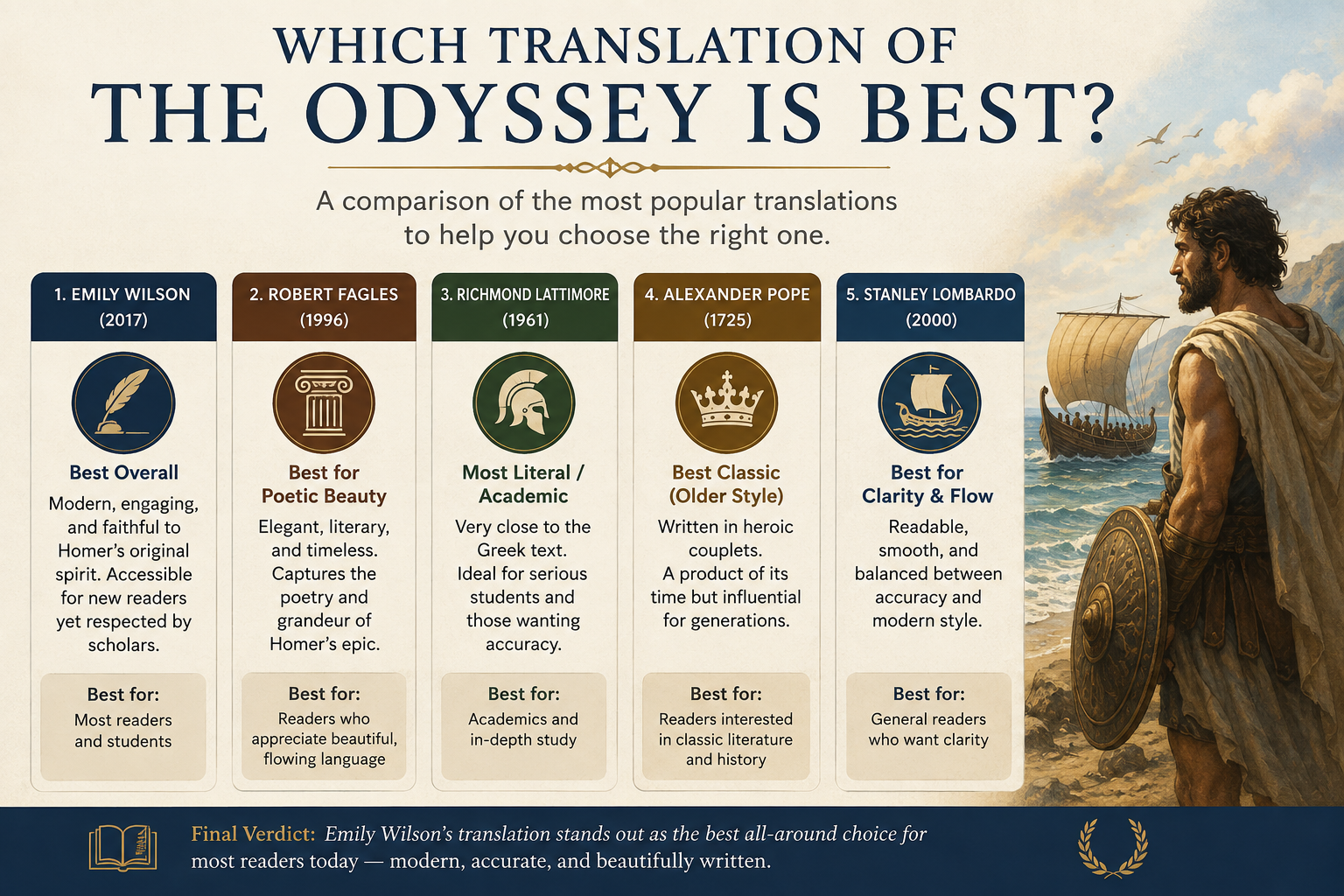
– Fagles is the cinematic, dramatic choice. Wilson is the clear, modern choice. Lattimore is the closest-to-the-Greek choice. Fitzgerald is the poetic choice. None of them is wrong.
– The same nuance problem that trips up Odyssey translators — one word carrying five defensible meanings — is exactly what trips up business and legal translation, which is where a service like Global Ethos Translation Company comes in.
## A reader lost at sea (in the bookstore)
Picture someone standing in the classics aisle, phone in hand, trying to figure out which copy of the Odyssey to buy before the movie comes out. There’s a slim orange paperback with a woman’s name on the spine. Next to it, a thicker one with a blurb calling it “the standard.” Behind that, a used copy from a college course with someone else’s highlighter marks still bleeding through the pages. They all claim to be the same book. None of them read the same way. That moment of hesitation — hand hovering, unsure which “Odyssey” is actually the Odyssey — is exactly the problem this article is here to solve, and it’s a much bigger problem than most “top 5” listicles let on.
## Why this question suddenly matters again
The timing isn’t random. Christopher Nolan’s 2026 film adaptation of the Odyssey, starring Matt Damon as Odysseus and Anne Hathaway as Penelope, has sent an entire generation back to the source material. The effect on book sales has been dramatic: Wilson’s translation reportedly saw print sales jump 700% in the UK in the week after the film’s release compared with the same week a year earlier, and it landed as high as the number 2 spot on U.S. bestseller lists months after its original 2017 release. American publisher W. W. Norton has confirmed that domestic sales across all formats of Wilson’s translation crossed one million copies in 2026 alone — a translation of a 2,700-year-old poem outselling most new novels. Nolan himself has pointed to Wilson’s opening line, “Tell me about a complicated man,” as the version that shaped his script’s take on the hero.
That’s the part everyone’s writing about. Here’s the part almost nobody is.
## The number nobody mentions: there are more than 60 of these
Most “best Odyssey translation” articles compare the same four or five names — Fagles, Wilson, Lattimore, Fitzgerald — and stop there, as if the field were small. It isn’t. English-language translators have been tackling the Odyssey since George Chapman’s version appeared around 1614–1616, the same Chapman that inspired John Keats’s famous sonnet about the thrill of discovering a book for the first time. Since then, more than 60 complete English translations have been published, running through Alexander Pope’s rhymed couplets in the 1720s, Samuel Butler’s plain public-domain prose in 1900, E.V. Rieu’s accessible prose that launched Penguin Classics in 1946, and dozens more.
Why does that matter to you as a reader? Because it means the “big five” translations aren’t the only legitimate options — they’re just the ones with the best marketing budgets. If you want something free and out of copyright, Butler’s prose or Pope’s verse are both a download away. If you want to see how attitudes toward Homer have shifted over four centuries, reading Chapman next to Wilson is a genuinely eye-opening exercise that almost no comparison article suggests, because it doesn’t fit neatly into a “top 5” format.
## Meet the contenders: strengths, weaknesses, and who each one is actually for
### Emily Wilson (2017) — the modern classic
**Strengths:** Wilson was the first woman to publish a complete English translation of the Odyssey, and she wrote it in iambic pentameter — a real, consistent English meter, not free verse dressed up as poetry. Her prose is lean, fast, and refuses to hide behind archaic language, which is why it’s become the default recommendation for first-time readers and classrooms.
**Weaknesses:** That same plainness is a drawback for readers who want the poem to sound “ancient.” Some critics feel Wilson trades a bit of grandeur for speed and clarity.
**Best for:** First-timers, students, and anyone who wants to actually finish the book.
### Robert Fagles (1996) — the cinematic favorite
**Strengths:** Fagles writes in a rolling, dramatic free verse that reads almost like a screenplay — full of energy, emotionally intense dialogue, and sweeping momentum. It’s the version that dominated university syllabi for two decades and is often called the most “heroic” rendering of Odysseus.
**Weaknesses:** Its drama comes partly from added color and idiom not literally present in the Greek, so it’s less useful for close textual study.
**Best for:** Readers who want the big, cinematic version, or who already loved Fagles’s Iliad.
### Richmond Lattimore (1965) — the scholar’s standard
**Strengths:** Lattimore stays as close to Homer’s Greek word order and line structure as English allows, preserving repeated epithets like “wine-dark sea” and “rosy-fingered dawn” exactly where Homer repeats them. It’s still considered the gold standard for classroom textual accuracy.
**Weaknesses:** That fidelity comes at the cost of pace — it’s a slower, more demanding read, especially for someone new to epic poetry.
**Best for:** Students, scholars, or second-time readers who want to see what the Greek is actually doing.
### Robert Fitzgerald (1961) — the poet’s choice
**Strengths:** Widely regarded as the most purely beautiful and lyrical English Odyssey, with a quieter, more haunting tone than Fagles or Wilson. It was the standard American translation for a generation and reportedly sold more than two million copies over its lifetime.
**Weaknesses:** It isn’t written in a fixed meter, and some readers find its quieter tone emotionally cooler or slower-moving than Fagles’s or Wilson’s.
**Best for:** Readers who care about the Odyssey as poetry first, story second.
### E.V. Rieu (1946) and other prose versions — the easy on-ramp
**Strengths:** Rieu’s prose translation launched Penguin Classics and reads almost like a novel, which makes it the least intimidating entry point for someone who finds poetry itself off-putting.
**Weaknesses:** Prose sacrifices the rhythm and oral, sung quality that defines the original — you get the story, not the music.
**Best for:** Readers who are intimidated by verse and just want the plot.
## The choice most articles skip: one Greek word, five different Odysseuses
Here’s the detail almost every comparison piece leaves out, and it’s the single best way to understand what a translator’s job actually involves. The very first line of the Odyssey describes its hero with the Greek word *polytropos*. There is no exact English equivalent, and the word a translator picks for it functions like a thesis statement for their entire 12,109-line project.
Lattimore renders Odysseus as a “man of many ways.” Fagles calls him “the man of twists and turns.” Fitzgerald goes with a “man skilled in all ways of contending.” Wilson breaks from all of them and simply writes “complicated.” That one word choice tells you, before you’ve read another line, whether you’re getting a wily trickster, a versatile survivor, or a morally ambiguous, psychologically real man — and it’s the clearest proof that translation isn’t a mechanical swap of words, it’s an interpretive act with real consequences for meaning.
## The stats behind the Nolan bump
A few numbers worth sitting with:
– Wilson’s translation has surpassed 1 million domestic copies sold across all formats as of 2026.
– Paperback sales of Wilson’s edition rose nearly 40% year-over-year even before the film’s release, then accelerated further afterward.
– UK print sales of “the Odyssey” (across editions) rose roughly 700% in the week following the film’s premiere compared to the same week the prior year.
– Nolan’s film opened to $263.7 million globally, and audiobook narrations by Stephen Fry and Ian McKellen simultaneously climbed into Spotify’s top 10 charts in the UK and US.
– Wilson herself has said that most retranslations of classical texts sell around 1,000 copies — meaning her book outperformed a typical scholarly translation by roughly a thousandfold.
That last stat is the one worth remembering: a “successful” academic retranslation used to mean a few thousand readers. Wilson’s edition rewrote what commercial success even looks like for a 2,700-year-old poem.
## Why this matters beyond the bookshelf
If a single Greek word can produce five legitimately different English heroes, imagine what’s at stake when the text in question is a contract, a medical consent form, or a product manual — except now there’s no room for five defensible interpretations, because only one of them can be legally or practically correct. This is precisely the gap that professional human translation exists to close, and it’s where **Global Ethos Translation Company** comes in: instead of a single freelancer’s best guess, you get subject-matter-qualified translators and a review process built to catch exactly the kind of ambiguity that turns “a man of many turns” into “complicated” — except in your documents, that kind of drift isn’t a stylistic choice, it’s a liability.
## Pros and cons at a glance
| Translation | Style | Pros | Cons |
|—|—|—|—|
| Wilson (2017) | Iambic pentameter, plain modern English | Fast, clear, great for beginners, gender-conscious reading of the text | Less “grand” sound for readers who want archaic majesty |
| Fagles (1996) | Dramatic free verse | Energetic, cinematic, classroom favorite for 25+ years | Adds idiom/color not literally in the Greek |
| Lattimore (1965) | Close, literal verse | Closest to the Greek structure and repetition | Slower, more demanding for first-time readers |
| Fitzgerald (1961) | Lyrical, poetic | Widely loved as pure poetry, sold 2M+ copies | No fixed meter; quieter, cooler emotional tone |
| Rieu (1946) / prose versions | Plain prose | Easiest entry point, reads like a novel | Loses the rhythm and sung quality of the original |
## So, which one should you actually read?
If you’re picking up the Odyssey for the first time, start with Wilson or Fagles — both move fast enough that you won’t stall out in book 4. If you already know the story and want to see what all the fuss over “faithfulness” is about, read Lattimore next and compare a single scene side by side with your first read. If poetry itself is what draws you to Homer, Fitzgerald rewards patience. And if you just want the plot without wrestling with verse at all, a good prose translation like Rieu’s will get you there fastest.
## Where Global Ethos Translation Company fits into your own translation questions
Reading five versions of the same 3,000-year-old poem is a fun way to see how much a translator’s choices shape a story — but if you’re dealing with translation in your own work or life (immigration paperwork, business contracts, academic transcripts, marketing copy going into a new market), you don’t get the luxury of comparing five interpretations and picking your favorite. You need the one version that’s accurate. That’s the exact problem Global Ethos Translation Company is built to solve: pairing native, subject-matter-qualified linguists with a quality-review process, so the words that reach your reader carry the meaning you intended — not just the meaning that survived a rushed first pass.
you can discover Translation vs. Interpretation Services: What Most Companies Get Wrong Before It Costs Them through this link https://global-ethos.com/translation-vs-interpretation/
## Conclusion
Homer’s Odyssey has survived more than 2,700 years, four centuries of English translators, and at least 60 attempts to get it “right” — and the truth this whole exercise reveals is that there was never going to be one final, definitive version, only different translators making different honest choices about the same untranslatable word. Christopher Nolan’s film has sent a new generation back to the bookstore to make that same choice for themselves, and now you know what you’re actually choosing between. So, given everything you now know about what a translator’s choices really do to a story — which Odysseus are you going to meet first?
## FAQ
**What is the most accurate translation of the Odyssey?**
Richmond Lattimore’s 1965 translation is generally considered the closest to Homer’s original Greek structure, meter, and repeated phrasing.
**What translation of the Odyssey did Christopher Nolan use for his 2026 film?**
Nolan has cited Emily Wilson’s 2017 translation as a key reference, specifically her opening line “Tell me about a complicated man.”
**Is Emily Wilson’s Odyssey good for beginners?**
Yes. It’s widely recommended as the best starting point for first-time readers because of its clear, modern, iambic-pentameter style.
**How many English translations of the Odyssey exist?**
More than 60 complete English translations have been published since George Chapman’s version in the 1610s.
**Is the Fagles or Wilson translation better?**
Neither is objectively better — Fagles is more dramatic and cinematic, while Wilson is leaner and more direct. The choice comes down to whether you want grandeur or speed.
**Why do translations of the Odyssey differ so much?**
Ancient Greek words like *polytropos* often have no single English equivalent, so translators must interpret meaning rather than swap words directly, which produces real differences in tone and character.
## Resources
– Britannica, “Odyssey: A Reader’s Guide to Homer’s Epic” — https://www.britannica.com/topic/Odyssey-epic-by-Homer/English-translations-and-legacy
– The Philadelphia Inquirer, “Penn professor Emily Wilson’s translation of ‘The Odyssey’ has more than a million readers” — https://www.inquirer.com/entertainment/movies/emily-wilson-upenn-odyssey-christopher-nolan-20260725.html
– PhillyVoice, “‘Odyssey’ movie boosts sales of Emily Wilson’s translation” — https://www.phillyvoice.com/odyssey-emily-wilson-book-sales/
– Slate, “The Odyssey Book Bump Is Real, and It’s Glorious” — https://slate.com/culture/2026/08/the-odyssey-movie-christopher-nolan-book-story-homer-emily-wilson-iliad.html
– Pappas Post, “Emily Wilson’s ‘Odyssey’ Surges Up Bestseller Lists as Nolan Sends Readers Back to Homer” — https://pappaspost.com/emily-wilsons-odyssey-surges-up-bestseller-lists-as-nolan-sends-readers-back-to-homer/
– Wikipedia, “English translations of Homer” — https://en.wikipedia.org/wiki/English_translations_of_Homer
– Wikipedia, “Odyssey (George Chapman translation)” — https://en.wikipedia.org/wiki/Odyssey_(George_Chapman_translation)
– Big Read Lakeshore, “The Odyssey: Choosing a Translation” — https://blogs.hope.edu/thebigread/big-read-2022/the-odyssey-choosing-a-translation/
– Study.com, “The Odyssey Translations: Examples & Historical Legacy” — https://study.com/academy/lesson/translations-of-the-odyssey-significance-in-history.html